
Introduction
Modern recycling plants utilise technologies such as screening, magnetic separation, air classification and optical sorting to efficiently separate valuable recyclable materials from mixed waste. From plastics and metals to paper, glass and organic waste, state-of-the-art recycling and sorting systems help to increase material recovery rates, reduce landfill volumes and support more efficient resource utilisation.
This article will provide a detailed overview of how recycling plants sort materials step by step, the equipment commonly used in the sorting process, and how different separation technologies are applied to various types of waste. We will also introduce key recycling equipment such as trommel screens, magnetic separators, air classifiers and eddy current separators, to help you better understand the complete recycling process and select the right solutions for your recycling plant.
Why Material Sorting Is Important in Recycling Plants
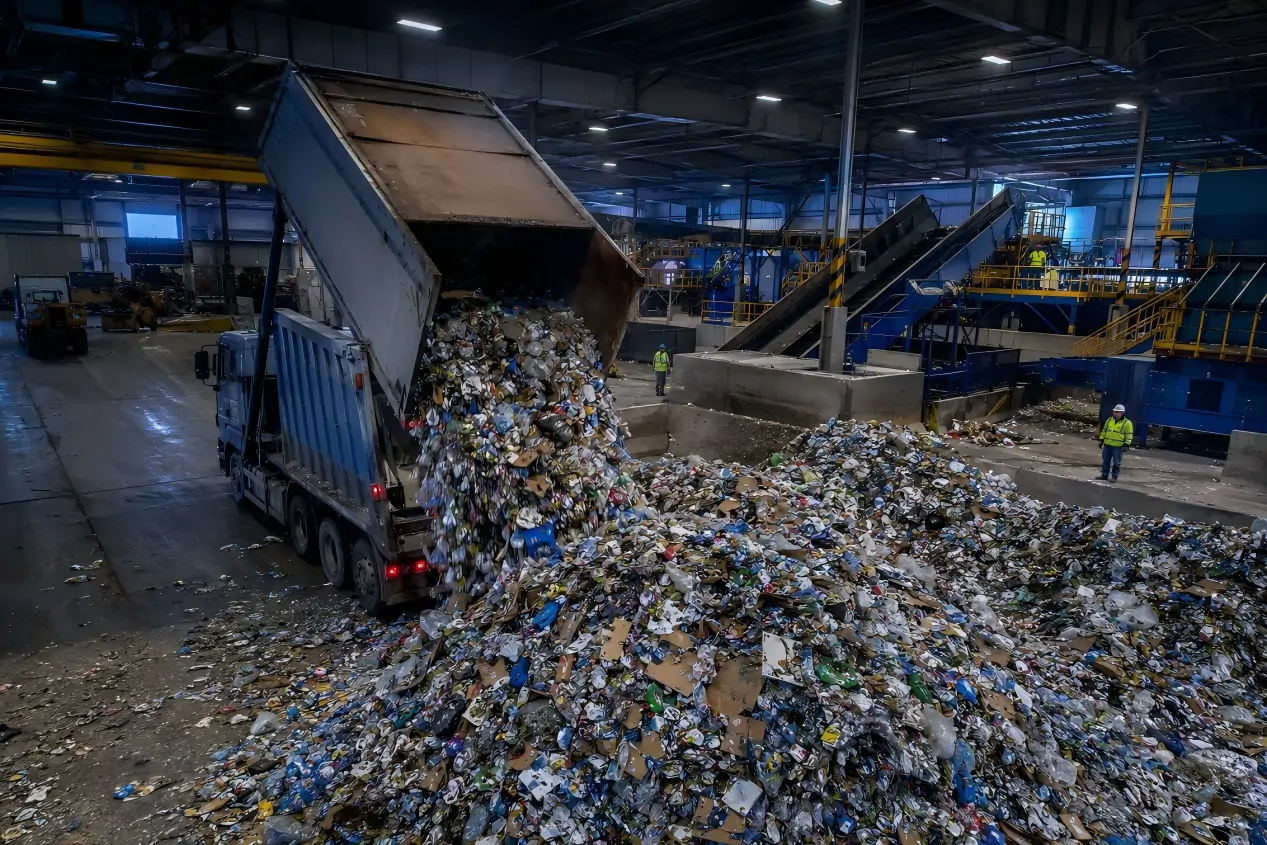
From an engineering perspective, raw waste is a chaotic mixture of highly contaminated inputs. The profitability of any material recovery facility depends entirely on front-end automated segregation. Implementing a high-precision waste sorting system is the only way to achieve the strict mechanical and optical purity required to transform bulk waste into high-value secondary commodities.
By optimizing recycling plant sorting process, can directly eliminate processing bottlenecks and maximize recycling efficiency across five critical engineering vectors:
- Maximizing Plant Throughput: Replacing manual lines with automated sensor-based and ballistic sorters ensures high-volume, continuous mass flow and stable cycle times.
- Minimizing Landfill Discards: High-capture efficiency prevents valuable recyclables from entering the reject stream, drastically reducing your landfill tipping fees.
- Securing High-Purity Outputs: Advanced optical sorting eliminates cross-contamination, delivering single-stream polymers and metals that command premium market prices.
- Ensuring Legal Compliance: An engineered sorting line provides the data-backed recovery rates and mass-balance traceability required to meet strict global environmental regulations.
- Optimizing RDF/SRF Feedstock: Precision sorting reliably isolates high-calorific materials while removing harmful PVC and organics, ensuring alternative fuels meet exact moisture and chlorine specs.
What Types of Materials Need to Be Sorted?
Modern recycling plants sort different materials to improve recycling efficiency, reduce landfill waste, and recover valuable resources. Depending on the waste stream, recycling systems separate materials by size, weight, density, magnetism, and composition. In many facilities, automated sorting lines can process more than 20 tons of mixed waste per hour.
Plastics
Plastic is one of the most important materials in recycling systems because different plastic types must be separated before reuse. If mixed together, recycled plastic quality drops significantly.
In recycling facilities, we commonly separate PET bottles, HDPE containers, plastic films, and rigid plastics using optical sorters, air classifiers, and density separation equipment. Advanced NIR optical sorting systems can identify plastic types with accuracy rates above 90%.
Common recyclable plastics include:
- PET beverage bottles
- Plastic packaging film
- Household containers
- Industrial plastic scrap
- Injection-molded plastic parts
Metals
Metals are highly recyclable and have strong recovery value, making metal separation a key process in modern recycling plants. Proper metal sorting also reduces raw material consumption and energy use.
Most facilities use magnetic separators for ferrous metals and eddy current separators for non-ferrous metals such as aluminum and copper. For example, recycling aluminum can save up to 95% of the energy required for primary aluminum production.
Common recyclable metals include:
- Steel scrap
- Aluminum cans
- Copper wire
- Automotive metal parts
- Electronic waste metals
Paper & Cardboard
Paper and cardboard are widely recycled into new packaging and paper products. Clean fiber separation is important because contaminated paper reduces recycling quality.
In recycling systems, we often use disc screens, ballistic separators, and air classifiers to separate cardboard from mixed paper waste. Corrugated cardboard remains one of the most recovered recyclable materials in municipal recycling plants.
Typical paper materials include:
- Corrugated cardboard
- Newspapers
- Office paper
- Paper packaging
- Cartons and paperboard
Glass
Glass recycling requires careful separation because ceramics, stones, and metals can contaminate recycled glass products. Many recycling plants also sort glass by color to improve recycling purity.
Modern glass recycling systems use crushing, screening, and density separation equipment to process glass efficiently. Recycled glass cullet can reduce furnace energy consumption during remelting.
Common glass materials include:
- Beverage bottles
- Food jars
- Flat glass
- Cosmetic containers
- Broken glass fragments
Organic Waste
Organic waste sorting helps convert biodegradable materials into compost, biogas, or organic fertilizer instead of sending them to landfills. In many cities, organic waste represents more than 30% of municipal solid waste.
Recycling facilities typically process food waste, agricultural residue, and garden waste using rotary trommel screens, dewatering systems, and composting equipment.
Common organic materials include:
- Food waste
- Garden waste
- Agricultural residue
- Wood chips
- Compostable materials
Construction & Demolition Waste
Construction and demolition waste contains heavy mixed materials that require large-scale screening and separation systems. Efficient sorting helps recover reusable aggregates and recyclable metals.
In C&D recycling plants, we commonly separate concrete, bricks, wood, and scrap metals using vibrating screens, crushers, magnetic separators, and air classifiers.
Typical C&D waste materials include:
- Concrete
- Asphalt
- Bricks
- Wood
- Scrap metal
- Drywall
Light Materials & Heavy Materials
Many recycling facilities also separate waste according to weight and density. This improves downstream sorting efficiency and reduces equipment wear.
Light materials are usually separated by airflow systems, while heavy materials are screened or gravity-separated. Air classifiers are especially effective for removing lightweight contaminants from mixed waste streams.
Light Materials
- Plastic film
- Paper
- Foam materials
- Textile fibers
Heavy Materials
- Metals
- Glass
- Stones
- Construction debris
Step-by-Step Guide to How Recycling Plants Sort Materials
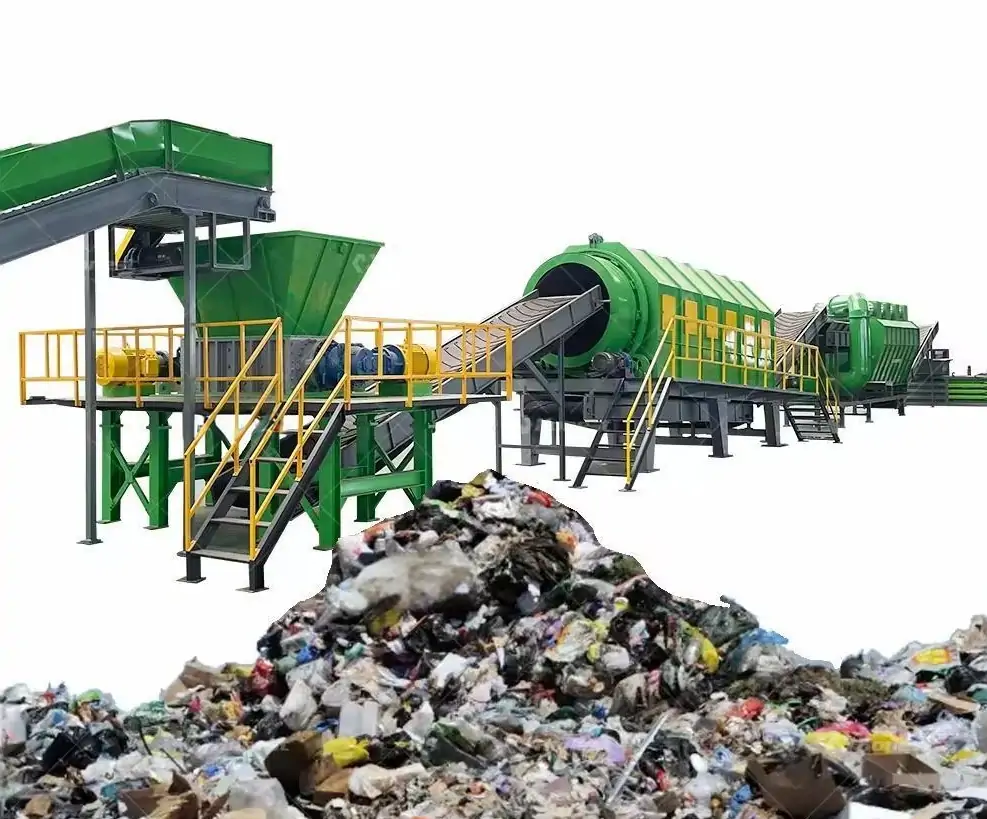
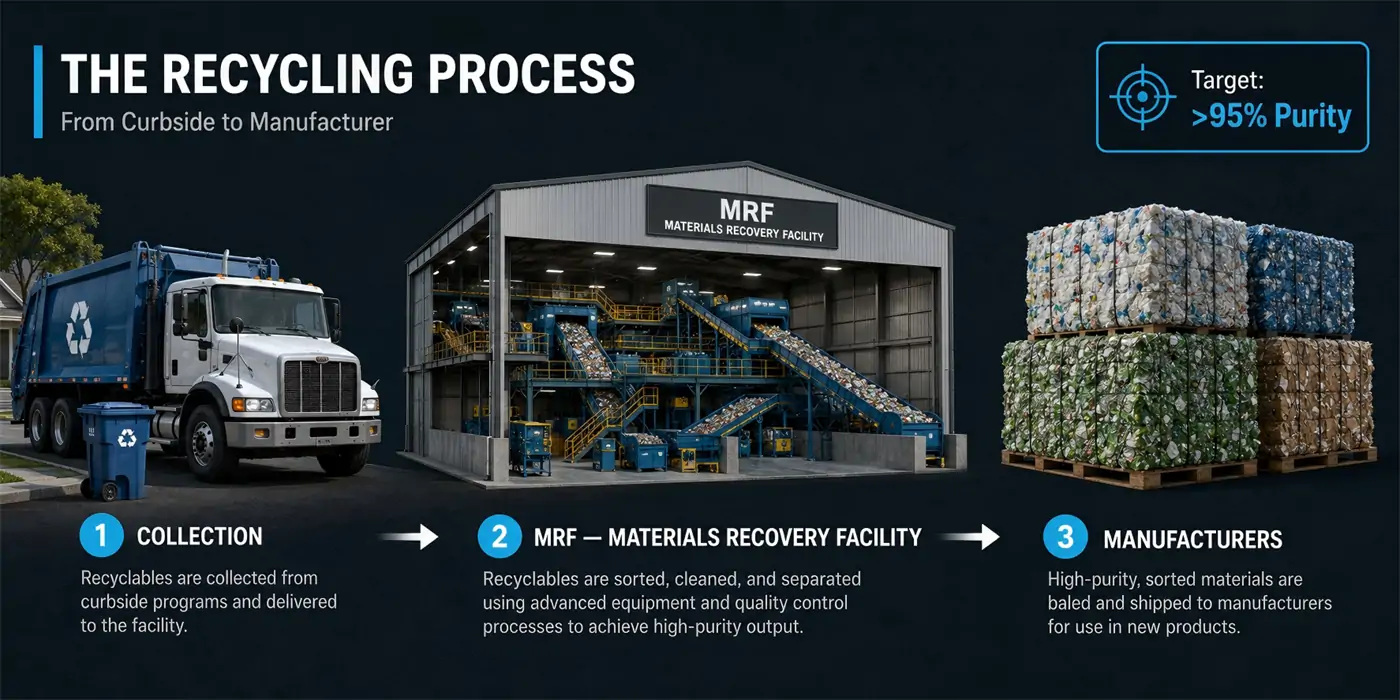
Recycling plants sort materials through a multi-stage process designed to improve recovery efficiency and reduce contamination. Most MRFs first remove oversized waste and non-recyclable materials, then separate recyclables by size, weight, magnetism, conductivity, and material type using screening, magnetic, air separation, and optical sorting equipment. The following are the specific steps:
Step 1 — Metering & Pre-Sort
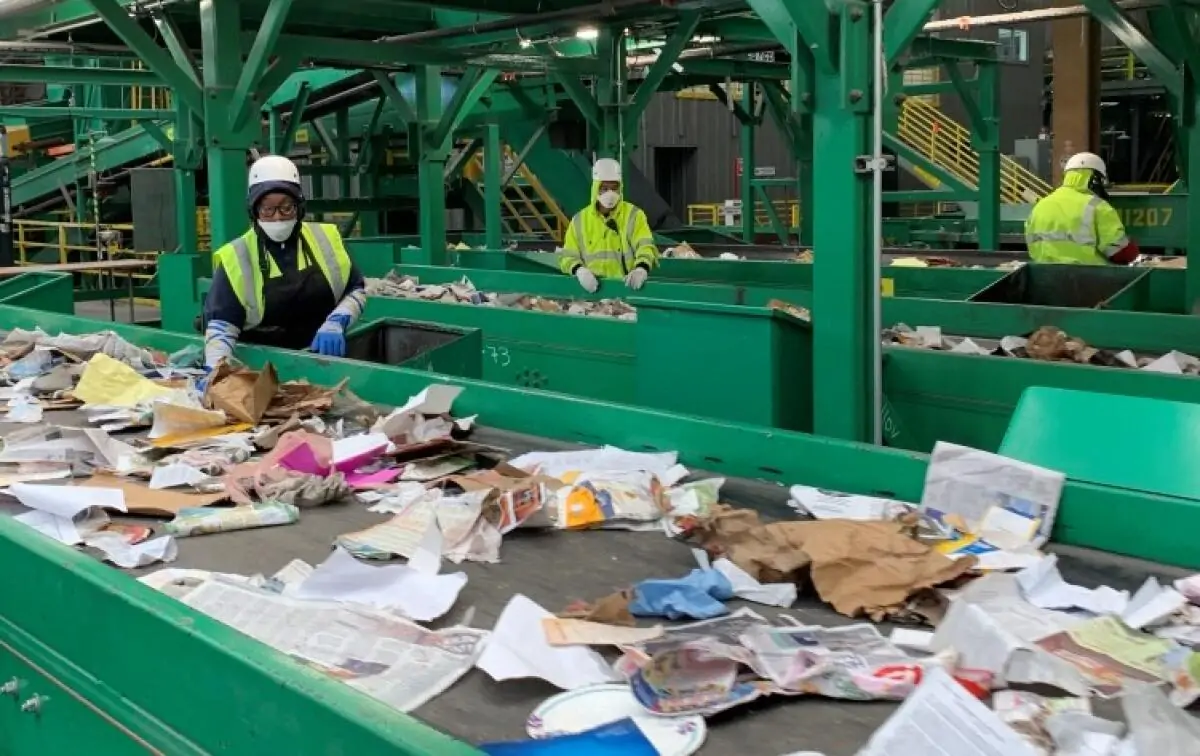
After the truck empties, a metering bin feeds material onto the conveyor at a controlled rate. Too fast, and downstream machines get overwhelmed; too slow, and you lose throughput. At the pre-sort station, one or two workers pull out obvious non-recyclables: plastic bags, wood chunks, hoses, and the occasional car battery. These items would jam screens or damage optical sorters. Many plants lose 5–10 minutes of uptime daily just to clear preventable jams — time you can save with a focused pre-sort routine.
Step 2 — Trommel Screening (Size Separation)
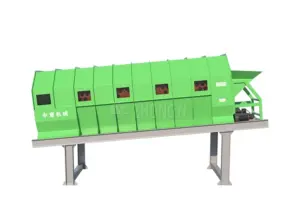
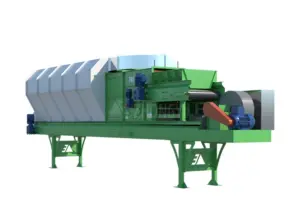
Material enters a large rotating drum with holes of different sizes. Small items — glass fragments, bottle caps, dirt — fall through first. Larger items — cardboard, plastic jugs, cans — travel to the end of the drum. A key operational detail: you can swap trommel screens for different hole diameters depending on your local waste composition. For example, a plant serving an area with heavy glass usage might use smaller holes to capture more cullet early, reducing glass breakage downstream.
Step 3 — Magnetic Separation (Ferrous Metals)
The remaining stream passes under an overband magnet hanging above the belt. It lifts out steel cans, scrap iron, and any other ferrous metal, dropping them into a separate bin. Keep the magnet belt clean — built-up debris can reduce magnetic force by as much as 30%, based on MRF maintenance data. A quick daily wipe-down takes two minutes and keeps your steel recovery high.
Step 4 — Eddy Current Separation (Non-Ferrous Metals)
Aluminum cans don’t stick to magnets. That’s where the eddy current separator comes in. It spins a magnetic rotor at high speed, inducing small electric currents in non-ferrous metals. Those currents create a repelling magnetic field that literally throws aluminum off the belt into its own collection chute. A common mistake: feeding too thick a layer over the eddy current. If material piles up, lighter aluminum can’t eject reliably. Keep the bed depth under two inches for best results.
Step 5 — Optical & NIR Sorting (Plastics)
Now you’re left mostly with plastics, paper, and maybe some glass. Optical sorters using near-infrared (NIR) cameras identify each plastic type by its unique spectral signature (PET, HDPE, PP, etc.) and blast it with a puff of air into the correct bin.
Calibrate the NIR sensor weekly — waste streams change seasonally. A well-calibrated sorter can hit 98% purity on PET. Let it drift, and you’ll see cross-contamination spike.
Step 6 — Air Classification (Light vs. Heavy)
An air classifier separates lightweight materials (films, shredded paper, plastic labels) from heavier ones using a controlled upward air stream. This step is often overlooked, but a simple air classifier can remove 80–90% of film contamination before it reaches your baler, saving you from costly rejected bales.
Step 7 — Baling & Quality Check
Every separated material stream ends at a hydraulic baler, compressing materials into dense bales — around 800 pounds for PET. Before baling, a final quality check (manual or camera-based) spots remaining contaminants. Pull a small sample from each bale once per shift and record its estimated purity. That log helps you spot a drifting sorter or torn screen days before a customer rejects your shipment.
6 Tips to Improve MRF Sorting Efficiency
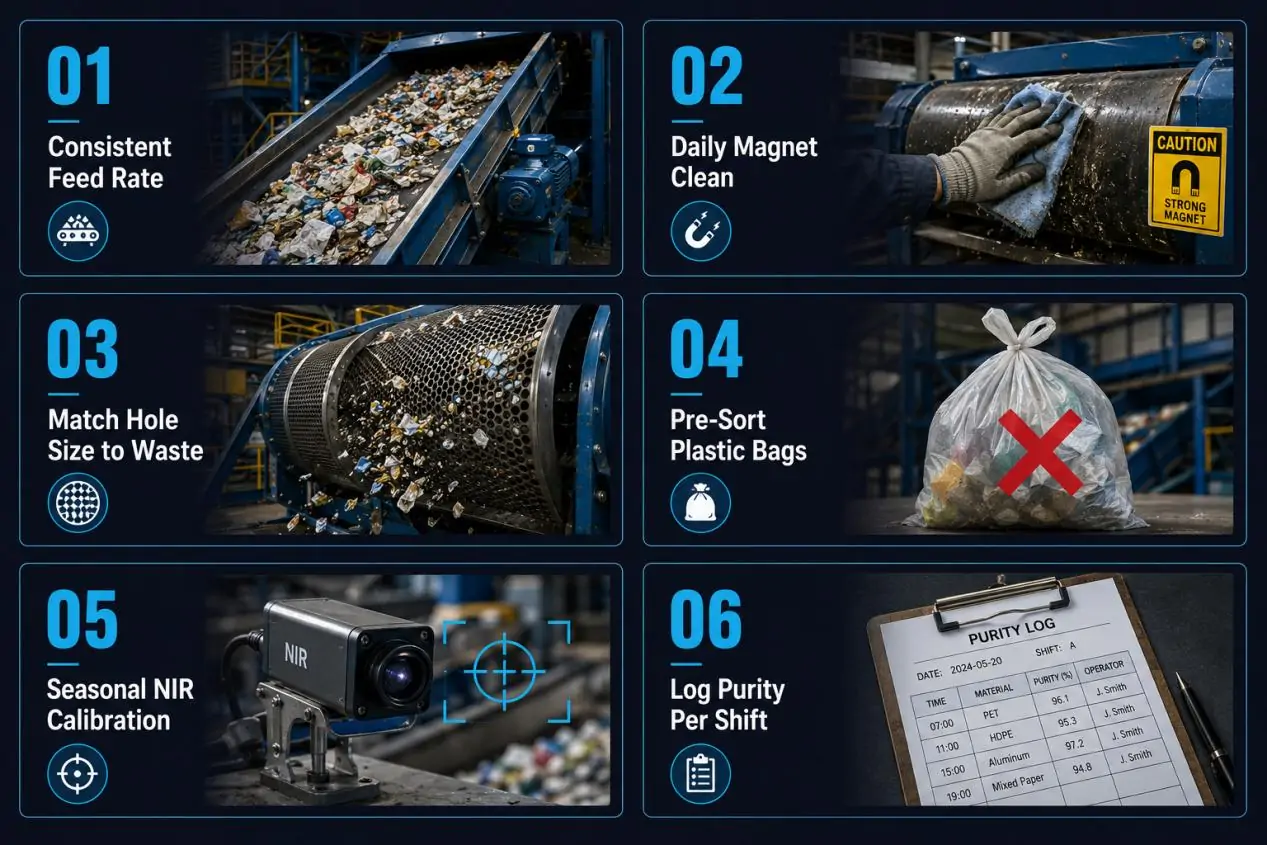
The operational efficiency of an MRF depends primarily on three factors: feed stability, sorting accuracy and equipment condition. If these three factors are well managed, it is usually possible to consistently increase recovery purity to 90%–95%, whilst reducing processing losses by 5%–15%.
1. Maintain a stable feed
Feed fluctuations are one of the most common issues. When material enters in a sudden surge, both screening and optical sorting become ‘overloaded’, leading to a decline in sorting accuracy; lightweight materials are easily misclassified or simply missed.
The recommended approach is straightforward: implement a buffer control at the feed end to prevent material from rushing directly into the main line. You can use a hopper or a variable-speed conveyor belt to keep feed fluctuations within ±10%, ensuring greater stability across the entire line.
2. Regularly clean magnetic separators and screens
Magnetic separators and screens are prone to material build-up during prolonged operation. If dust or fine particles adhere to the surface of the magnetic rollers, iron recovery efficiency may drop by 20% or more. Clogged screen mesh also directly affects processing capacity.
We recommend spending 2–3 minutes checking the condition of the magnetic separator and screens before starting up each day. A simple clean is sufficient; there is no need for a major shutdown for maintenance, but this must become a habit, otherwise efficiency will continue to decline.
3. Select screen mesh sizes appropriately
Screen mesh size directly affects output and sorting accuracy. Too fine a mesh can improve purity but will reduce throughput; too coarse a mesh will increase the burden on downstream sorting.
We recommend that you do not simply opt for the ‘finest’ option, but instead conduct comparative tests. Run the same material through 2–3 different mesh sizes, recording output and purity data; you will generally find an ‘optimal cost-effectiveness point’.
4. Remove plastic bags and film in advance
Plastic bags and film are the primary sources of interference in optical sorting systems. NIR optical equipment cannot see through opaque film, and plastic bags can easily become entangled in sensors or rollers, causing misidentification.
It is recommended to carry out pre-processing before the material enters the optical sorting system, such as manual sorting or air separation, to remove the majority of bagged materials in advance. Typically, reducing film content by 70%–90% can significantly improve downstream recognition accuracy.
5. Regularly calibrate the optical sorting system
The composition of household waste varies with the seasons; for example, PET bottles and HDPE personal care products account for a higher proportion in summer, whilst the proportion of PP food containers increases in winter. If parameters are not adjusted, recognition errors will gradually accumulate.
It is recommended that you calibrate the NIR system at least once every 1–2 weeks and update the recognition library based on the actual material. This will help maintain plastic purity at a stable level of around 95% over the long term.
6. Record Sorting Purity Once Per Shift
Many issues do not arise suddenly but accumulate gradually, such as damaged screens, unstable airflow or sensor drift. Without data, it is difficult to detect these problems in advance.
We recommend conducting a simple sampling test during each shift to record the proportion of contaminants in key materials such as metal, plastic and paper. By maintaining consistent records, you will quickly identify anomalies and address them before they escalate.
How High-Throughput MRFs Handle Sorting at Scale
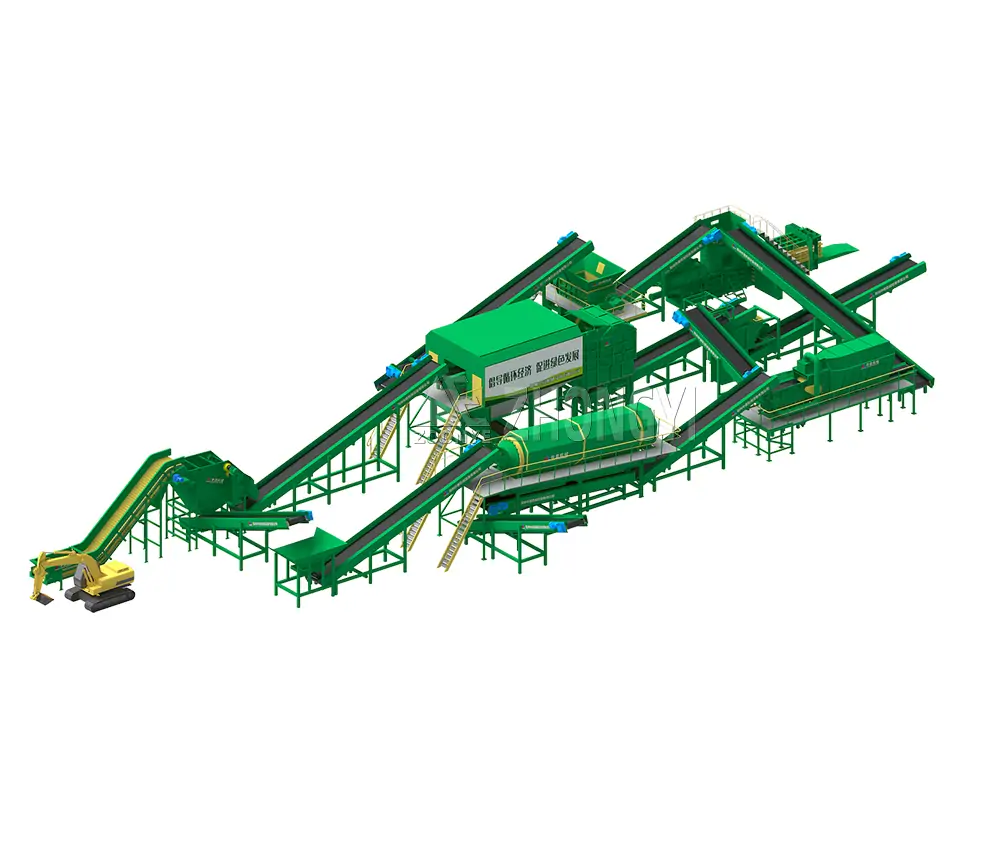
A small recycling line processing 5 tons per day can manage with basic machines and manual sorting. But scale up to 50 or 100 tons daily, and those methods break down fast — the belt moves too quickly, and human error compounds. At industrial volume, you need multiple layers of separation: two trommels in parallel, three optical sorters covering the same stream, and a ballistic separator that pre-splits 2D (paper, film) from 3D (bottles, cans) before either hits the NIR cameras.
Zhongyi builds modular sorting systems that scale from single-line configurations up to dual-line setups handling 80+ tons per hour. The underlying principles stay the same — separate by size, then by material property — but at scale, the key is how many times you run each step and how much automation you layer on top.
Equipments for Sorting Recyclables
Each machine on a sorting line solves one specific separation problem. Here’s the core equipment you need:
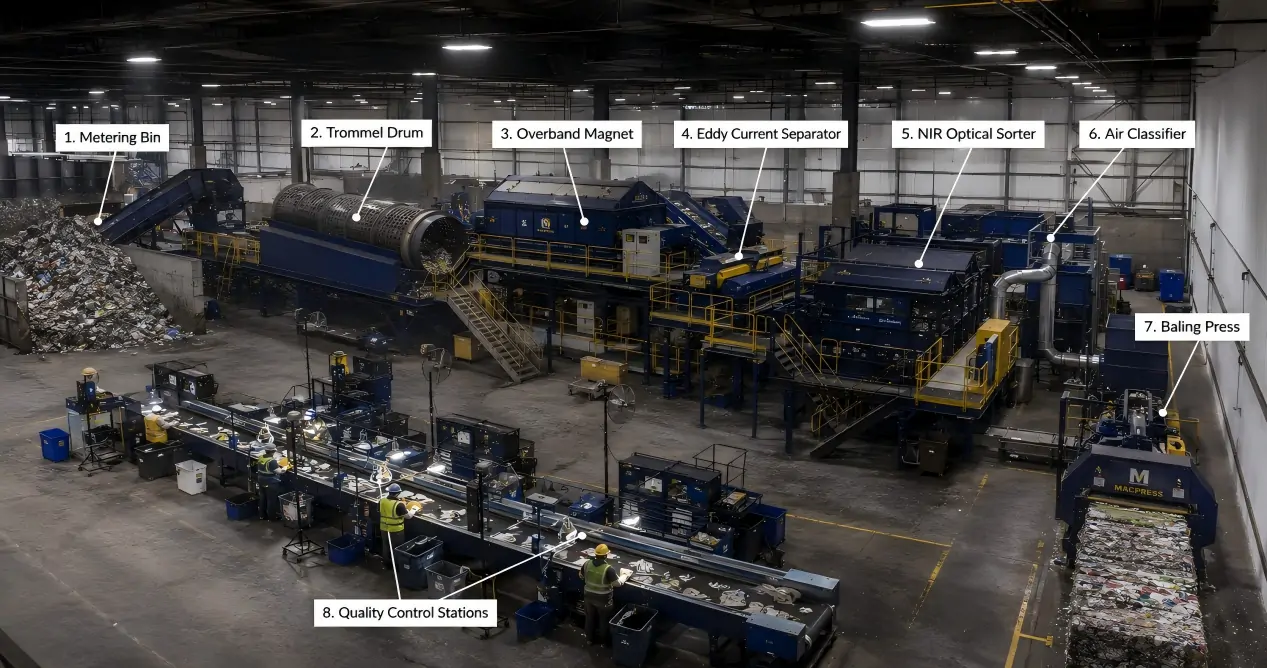
Trommel / Disc Screen —
Rotating drums that separate by size. Your first line of defense.
Overband Magnet
A suspended electromagnet pulling steel and iron off the belt. Install one after the trommel and another near the end to catch missed pieces.
Eddy Current Separator
Uses a high-speed magnetic rotor to repel aluminum and copper off the belt. Essential for recovering high-value non-ferrous metals.
Optical / NIR Sorter
NIR cameras identify plastic types and trigger air jets. This is where real purity happens.
Air Classifier
Blows a controlled air stream to lift out film and light materials. A cost-effective fix for film contamination.
Match each machine to one specific material property, and your purity will follow.
Conclusion
In summary, recycling plants rely on a combination of screening, magnetic separation, air classification, and advanced sorting technologies to efficiently separate mixed waste into valuable recyclable materials. Each stage of the process plays a specific role in improving recovery rates, reducing contamination, and ensuring that materials such as metals, plastics, paper, and aggregates can be reused effectively.
Understanding how these systems work helps you better evaluate equipment selection and plant design for different recycling applications. If you have specific requirements or need support for a recycling or waste sorting project, you are welcome to contact the Zhongyi technical team for further consultation and solutions.


Andy Yu
Technical Engineer | Zhongyi ECO
16+
Years Exp.
300+
Solutions
50+
Countries
16 years’ experience in environmental and solid waste management, specializing in C&D recycling and waste sorting solutions. At Zhongyi Mining Machinery, focused on improving global clients’ efficiency through technical expertise and tailored configurations.
FAQs
Recycling plants use a combination of screening, magnetic, air, and optical systems. Common equipment includes trommel screens, vibrating screens, magnetic separators, eddy current separators, air classifiers, and NIR optical sorters. A typical MRF line can handle 10–40 tons of mixed waste per hour depending on configuration.
Plastics are separated using size screening, air separation, optical sorting, and density separation. NIR optical sorters identify resin types such as PET, HDPE, PP, and PVC, with sorting accuracy often above 90% in modern systems. Sink-float tanks are also used to improve final plastic purity.
The main challenge is contamination from mixed and dirty waste streams. Items like plastic bags, wet paper, and mixed packaging can reduce sorting efficiency and lower material value. In some cases, contamination can reduce recycling quality by 10%–20% if not properly controlled.
Yes, but it requires different processing stages. Construction waste (concrete, bricks, metals) is usually processed with heavy-duty crushing and screening systems, while household waste needs finer sorting and optical separation. Many plants separate these streams at the front end to improve efficiency.
Efficiency is improved through stable feeding, proper equipment selection, and regular maintenance. For example, keeping feed variation within ±10% and cleaning magnetic separators daily can significantly reduce downtime and improve recovery rates by 5%–15%.
Recycling plants can recover a wide range of materials including plastics, metals, paper, cardboard, glass, organic waste, and construction aggregates. High-performance systems can achieve material recovery rates of 70%–90% depending on waste composition and sorting technology.