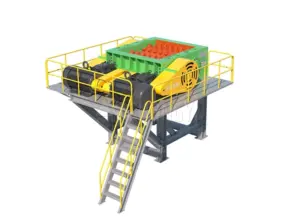
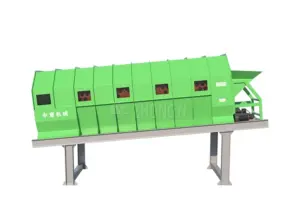
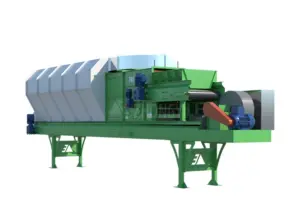

What is a Circular Motion Flip Flow Screen?
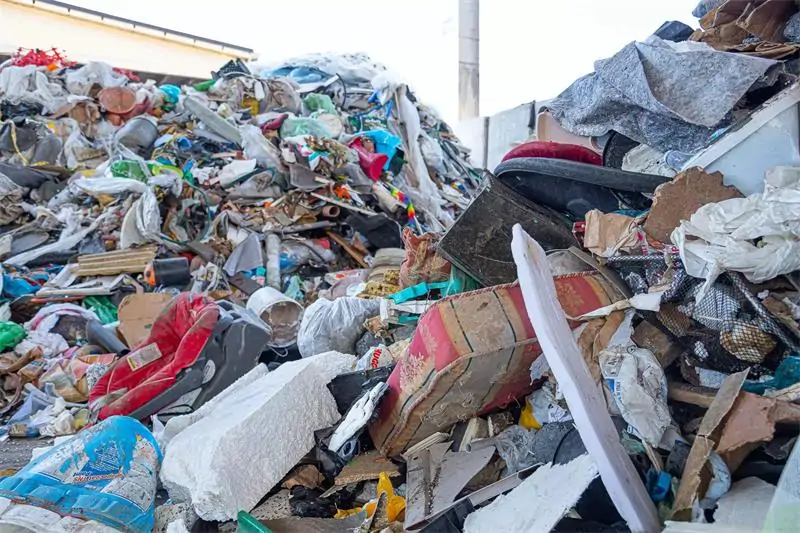
Circular Motion Flip Flow Screen is a stepped bar elastic screening system designed for high-moisture, sticky and mixed solid waste. It is widely used in MSW, RDF, compost and sludge treatment, where traditional vibrating screens easily clog and lose efficiency.
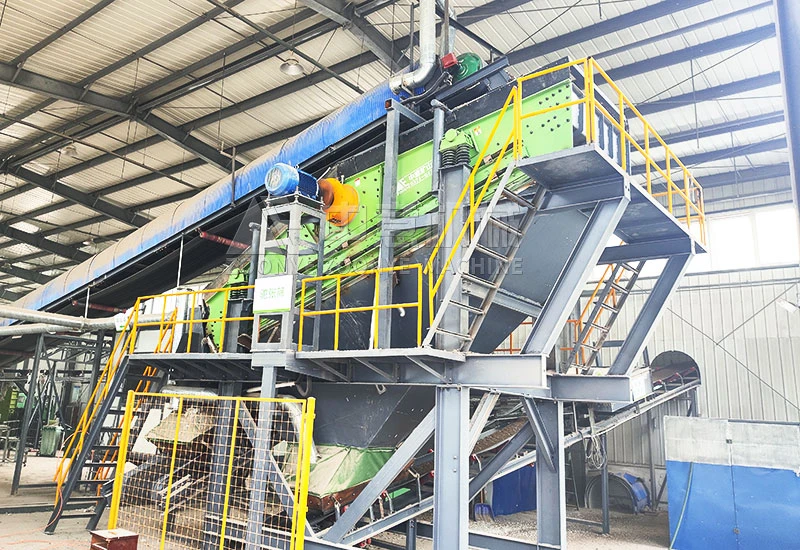
Developed by Xinzhongyi ECO, it uses a stepped structure with elastic flip-flow mats that continuously stretch and relax. This motion breaks wet agglomerates, prevents clogging, and improves separation into coarse, fine and light fractions in full recycling plant systems.


Applicable Materials
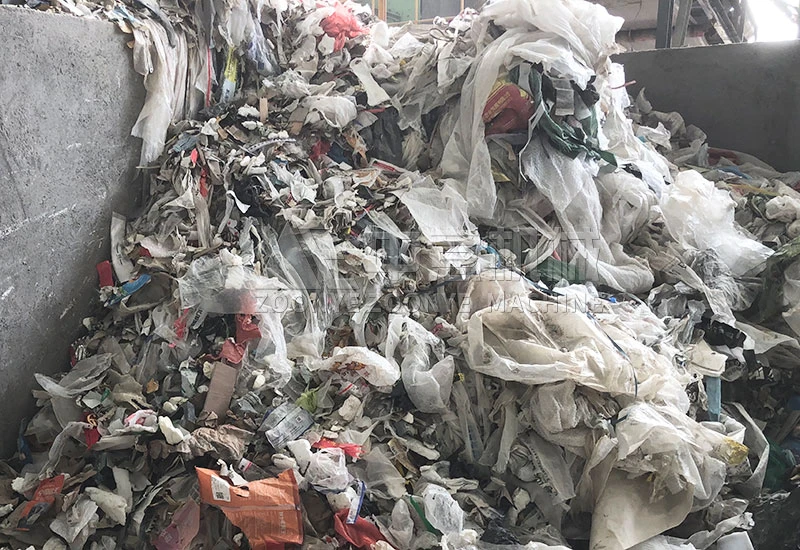
The Circular Motion Flip Flow Vibrating Screen is primarily suitable for screening materials that are moist, highly viscous, prone to agglomeration, or likely to clog the screen mesh. Common materials include coal, coke, ore, quartz sand, construction aggregates, tailings, metallurgical intermediate products, and certain chemical raw materials. This equipment offers strong adaptability to various materials and is particularly well-suited for applications involving high moisture content or a high proportion of fine particles, effectively reducing screen clogging and material adhesion.
Generally, the feed size range can be controlled between 0–100 mm or larger (depending on the model and configuration), making it suitable for pre-screening or classification of medium- to fine-grained materials and certain medium- to coarse-grained materials. Multi-stage screening is typically achievable within a particle size range of approximately 0.5–50 mm, commonly configured with 2–3 stages or more. Screen mesh specifications can be flexibly adjusted according to process requirements to achieve precise separation and efficient processing.
Working Principle
The Circular Motion Screening Machine achieves material classification through a combination of circular motion and the elastic flipping of the screen mesh. During operation, the screen box moves in a circular path, and the material continuously moves forward along the screen surface due to inertia; at the same time, the screen mesh undergoes continuous up-and-down flipping due to its elasticity, causing fine particles adhering near the screen apertures to be constantly shaken loose and re-introduced into the screening process.
Under this motion pattern, the material layer remains relatively loose at all times, allowing fine particles to pass through the screen apertures more easily, while coarse particles are steadily conveyed along the screen surface to the discharge end to complete the separation. The circular conveying ensures high throughput, and the flipping of the screen surface reduces clogging and adhesion issues, enabling the equipment to maintain stable screening efficiency even when processing materials with high moisture content or a tendency to agglomerate.
Parts
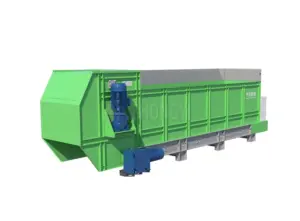
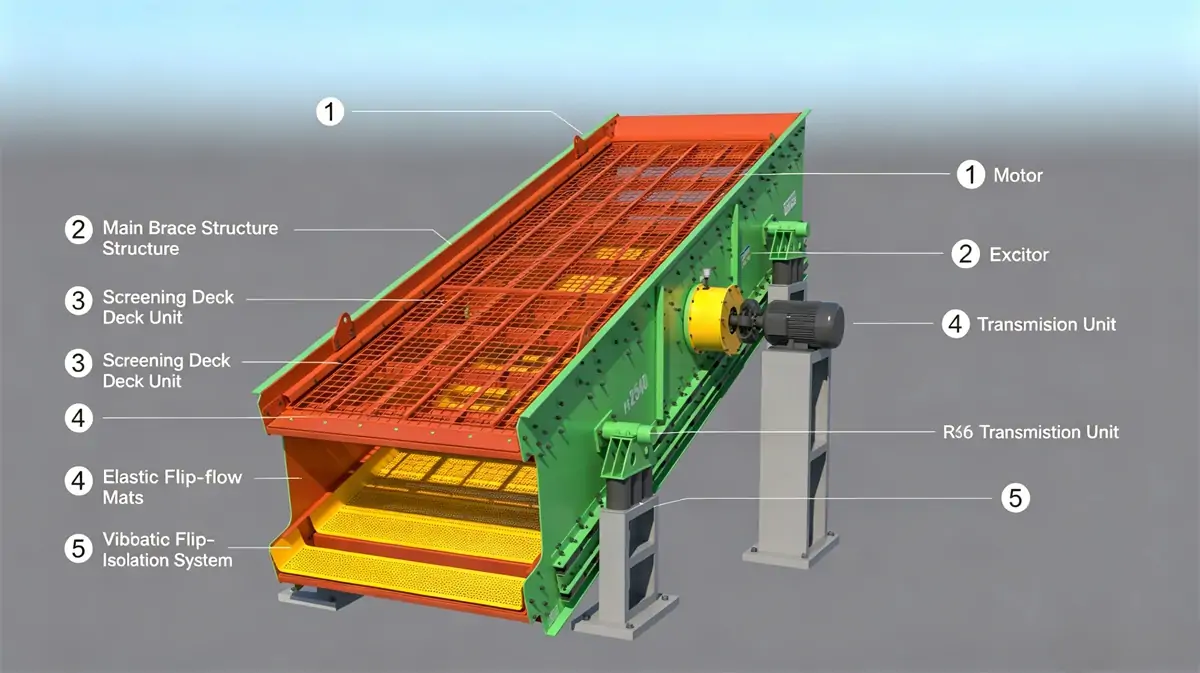
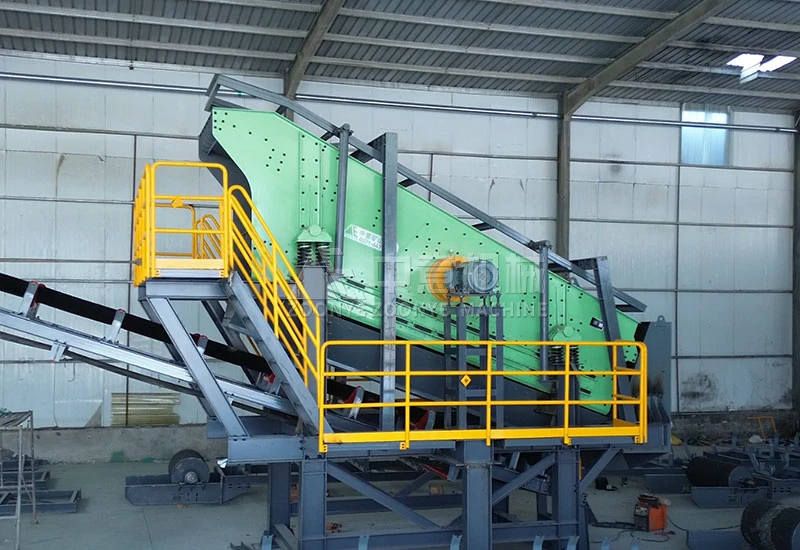
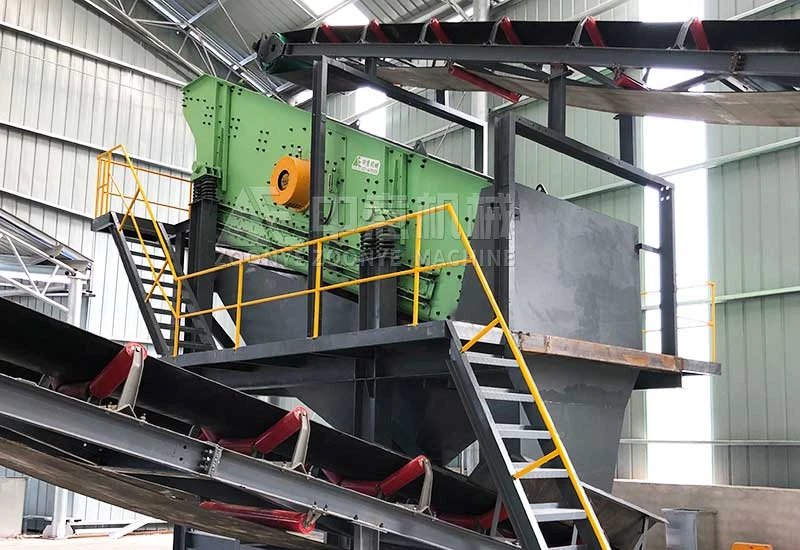
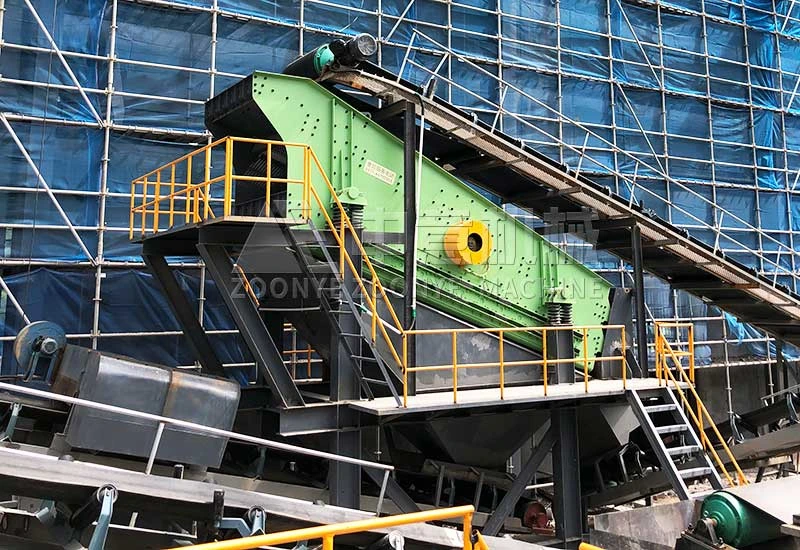
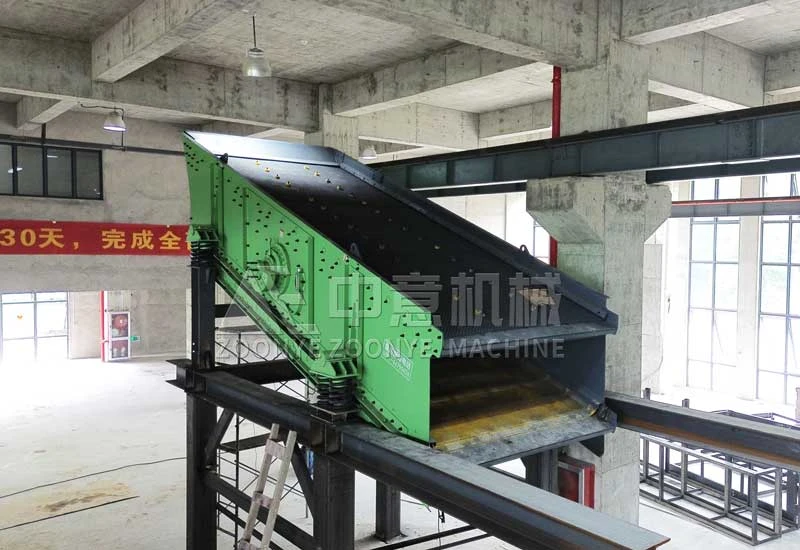
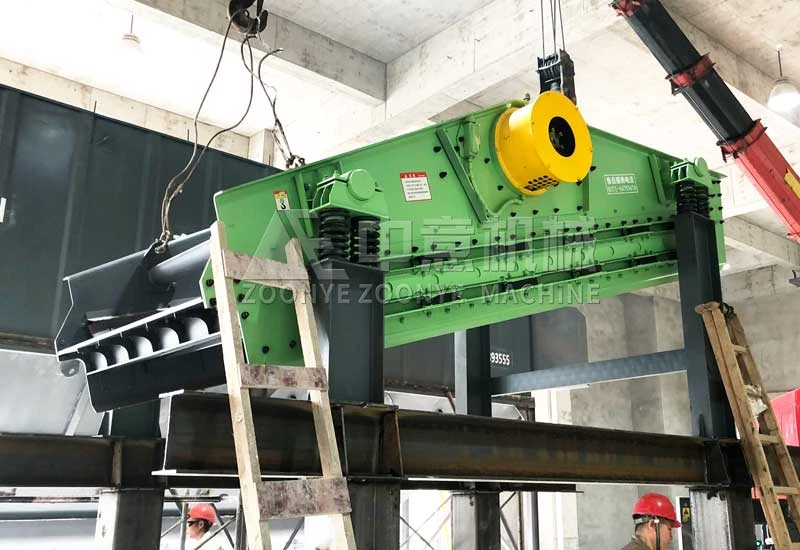
The Flip Flow Vibrating Screen Machine includes drive system, screening deck, flip-flow mats, main frame, isolation system, and control system. These parts work together to screen wet and mixed waste under vibration and elastic motion.
- Drive System
Motor, exciter, and transmission unit provide power. It creates circular vibration and allows speed adjustment by frequency control. - Screening Deck Unit
Stepped steel frame supports material flow. It spreads material evenly and helps forward movement for better separation. - Elastic Flip-Flow Mats
Polyurethane mats stretch and relax during operation. This motion breaks wet clumps and reduces screen blockage. - Main Frame Structure
Welded steel frame supports all parts. It keeps the machine stable under continuous vibration and load. - Vibration Isolation System
Rubber or steel springs reduce vibration transfer. It protects the foundation and improves running stability. - Electrical Control System
PLC, inverter, and sensors control operation. It adjusts speed and vibration based on material conditions.
Specifications
The main specifications of the Circular Flip Flow Screen include screen surface area, number of layers, feed particle size, processing capacity, vibration parameters, and drive power. The specific configuration is determined based on operating conditions and material characteristics; see the table below for detailed parameters.
| Model | Power (kW) | Capacity (m³/h) |
|---|---|---|
| YKF1540 | 7.5 | 20–120 |
| YKF1548 | 11 | 20–150 |
| YKF1848 | 15 | 30–180 |
| YKF1860 | 18.5 | 30–200 |
| YKF2160 | 22 | 45–350 |
| YKF2460 | 22 | 60–380 |
| 2YKF1548 | 15 | 20–150 |
| 3YKF1548 | 18.5 | 20–150 |
| 2YKF1860 | 22 | 30–200 |
| 3YKF1860 | 30 | 30–200 |
| 2YKF2160 | 22 | 45–350 |
| 3YKF2160 | 30 | 45–350 |
| 2YKF2460 | 30 | 60–380 |
| 3YKF2460 | 30 | 60–380 |
| 2YKF3060 | 37 | 70–500 |
| 3YKF3060 | 45 | 70–500 |
Advantages
The Circular Motion Flip Flow Screen features a simple design and stable operation, making it suitable for continuous screening of highly moist and sticky materials. Through its composite motion mechanism, the equipment effectively reduces screen clogging and material adhesion, maintaining stable screening throughput and efficiency. It also offers excellent self-cleaning capabilities and requires minimal maintenance. With low overall energy consumption and strong adaptability, it can achieve stable classification under a variety of complex operating conditions.
Applications
The Flip Flow Screen is primarily used for the efficient screening and classification of materials with high moisture content that are prone to agglomeration and screen-opening blockage. It also performs functions such as dewatering, pre-screening, and fine-particle recovery. Through a combination of circular conveying and the elastic flipping motion of the screen surface, the equipment continuously breaks up material agglomerations and clears screen-opening blockages, thereby improving the efficiency of fine-particle screening while maintaining throughput. It offers high operational stability and low maintenance requirements.
This equipment is widely used in coal washing and beneficiation, metallurgical mining, sand and gravel aggregates, tailings treatment, power plant fuel pretreatment, as well as the chemical and building materials industries. In the coal industry, it is commonly used for raw coal classification and fine coal dewatering; in the mining and metallurgical sectors, it is suitable for screening fine-grained minerals and tailings recovery; in sand, gravel, and aggregate systems, it is used for wet screening and pre-classification prior to product shaping; and it is also suitable for pretreatment applications involving materials with high clay content.
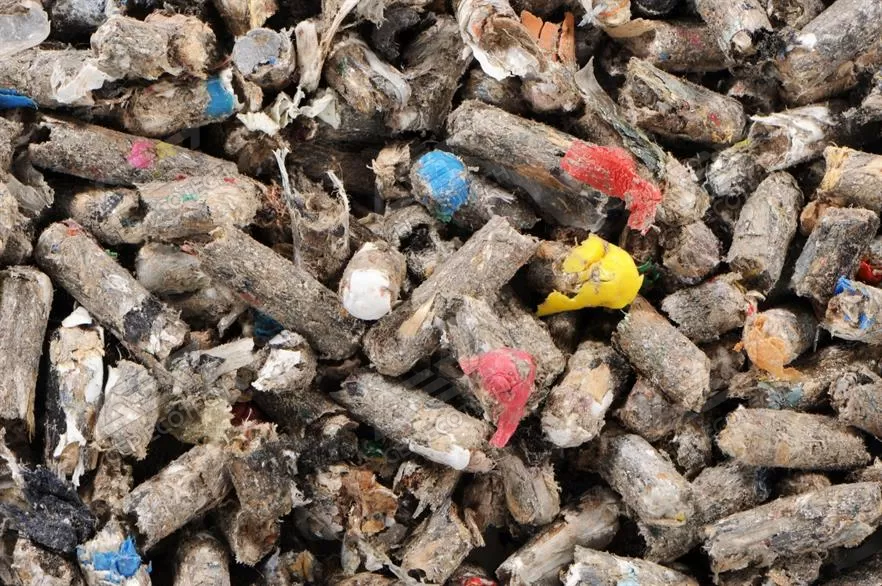
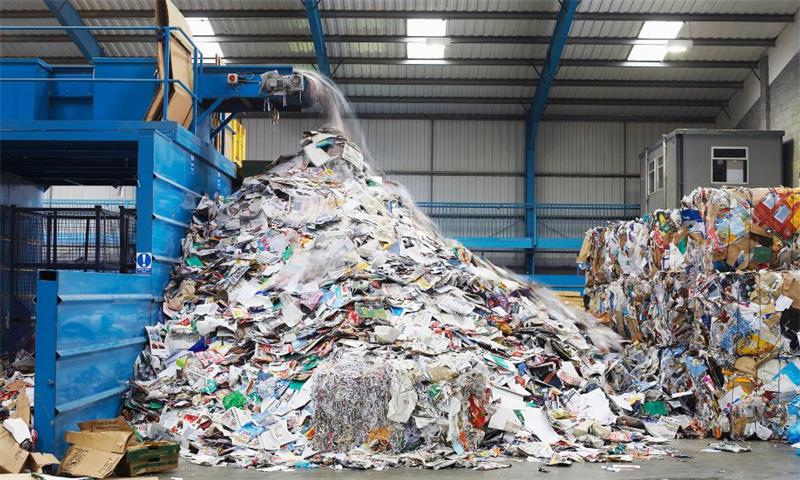
Municipal Solid Waste (MSW) Sorting Plants:
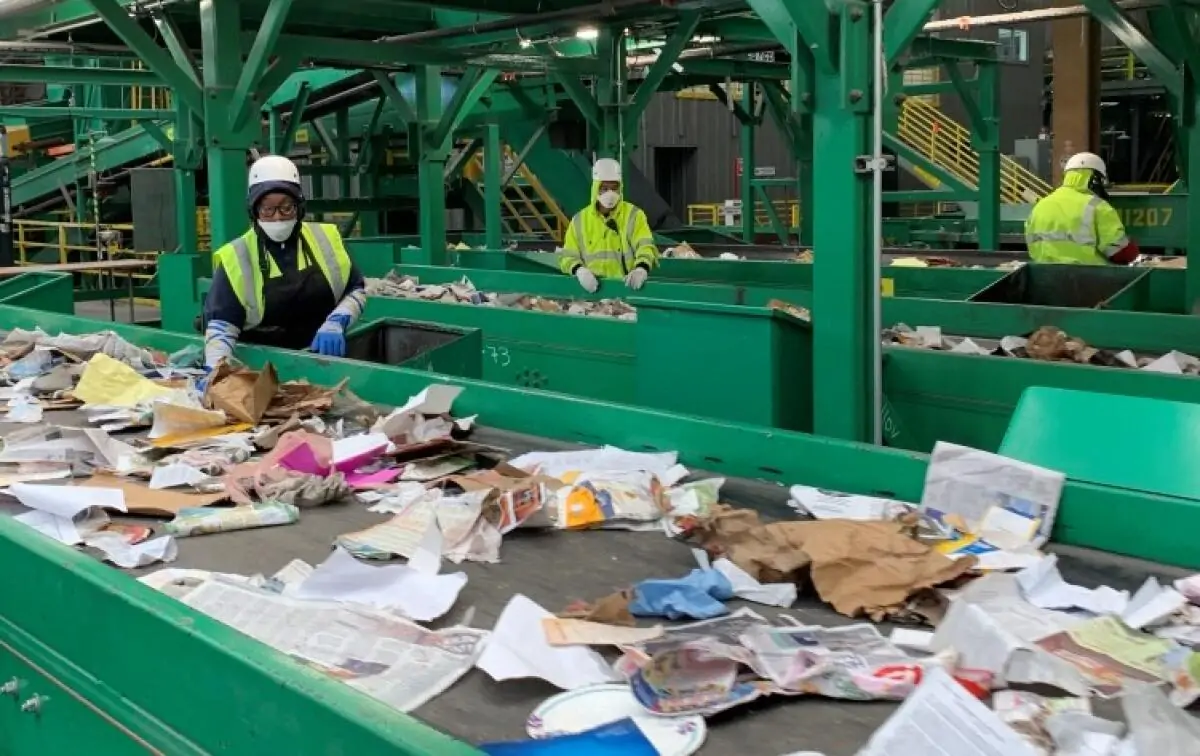
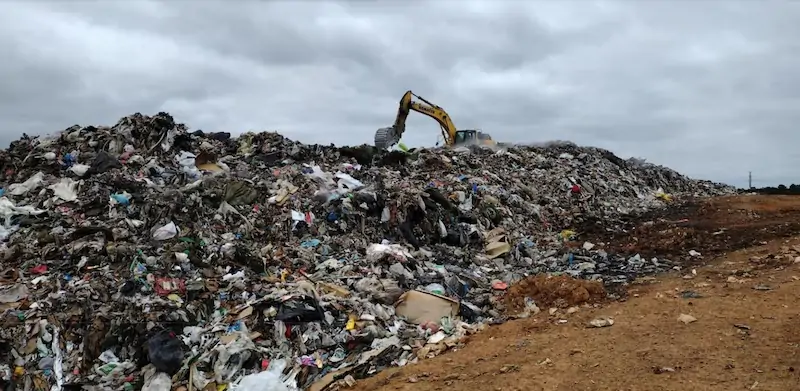
Used in mixed household waste processing lines. It separates organic waste, fine particles, and light materials such as plastics and paper. It helps stabilize uneven incoming waste.
RDF / SRF Fuel Preparation Systems:
Used before fuel production. It removes fines, moisture-rich materials, and incombustible impurities. This helps keep the fuel fraction more consistent for combustion use.
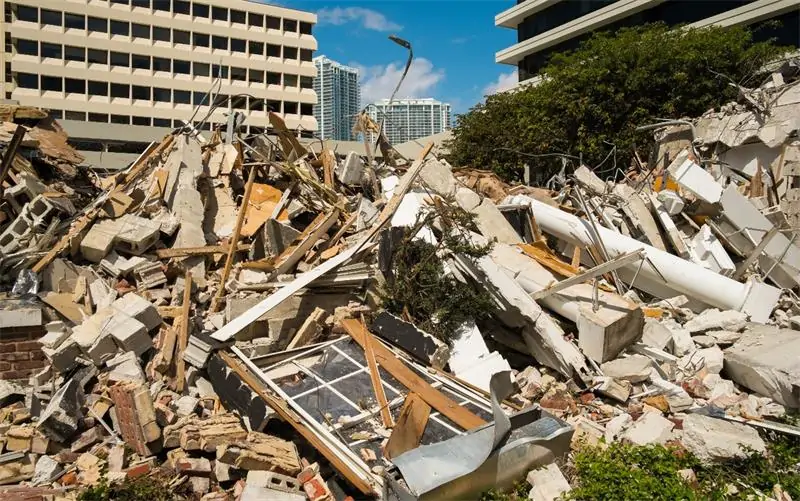
Construction & Demolition Waste Recycling:
Used for crushed construction waste containing soil, sand, bricks, and mixed debris. It separates fine materials from coarse fractions before further crushing or sorting.
Organic Waste Compost Screening:
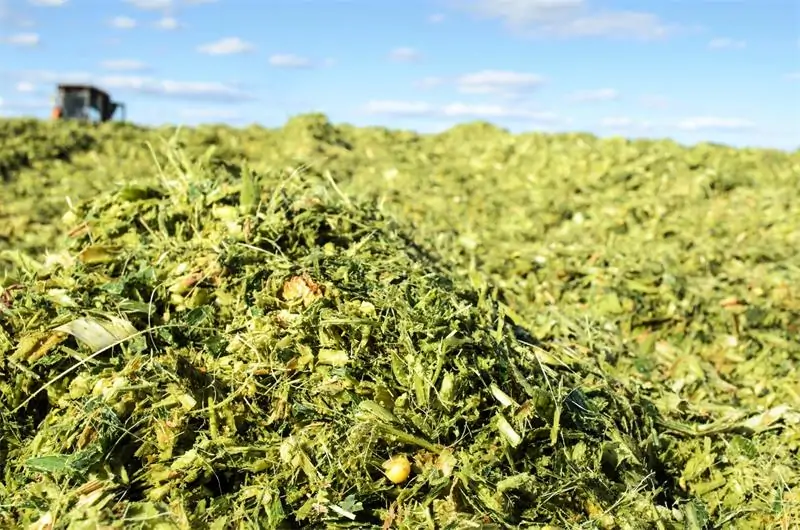
Used after fermentation or pre-treatment of organic waste. It breaks up wet clumps and removes oversized impurities to keep compost material uniform.
Biomass Fuel Processing:
Used for screening straw, wood chips, and agricultural residues. It helps remove fines and improves particle consistency before fuel production.
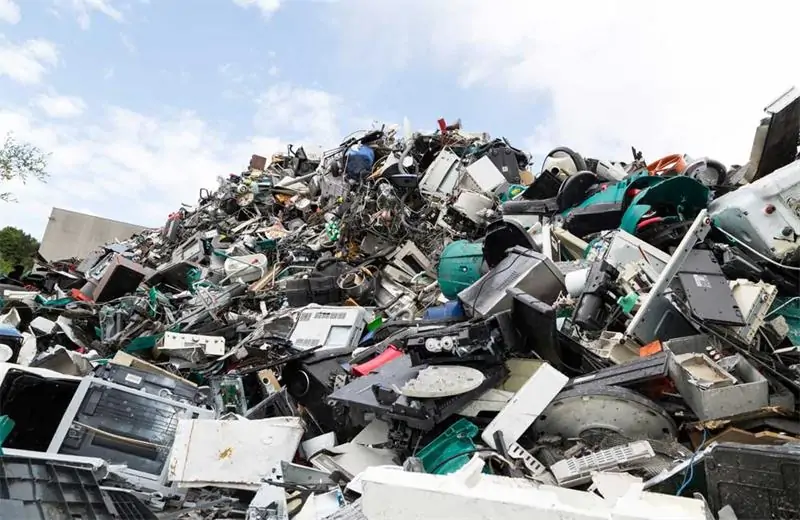
Industrial Waste Pretreatment Systems:
Used in mixed industrial waste streams before shredding or sorting. It helps separate unstable materials and reduces load on downstream equipment.
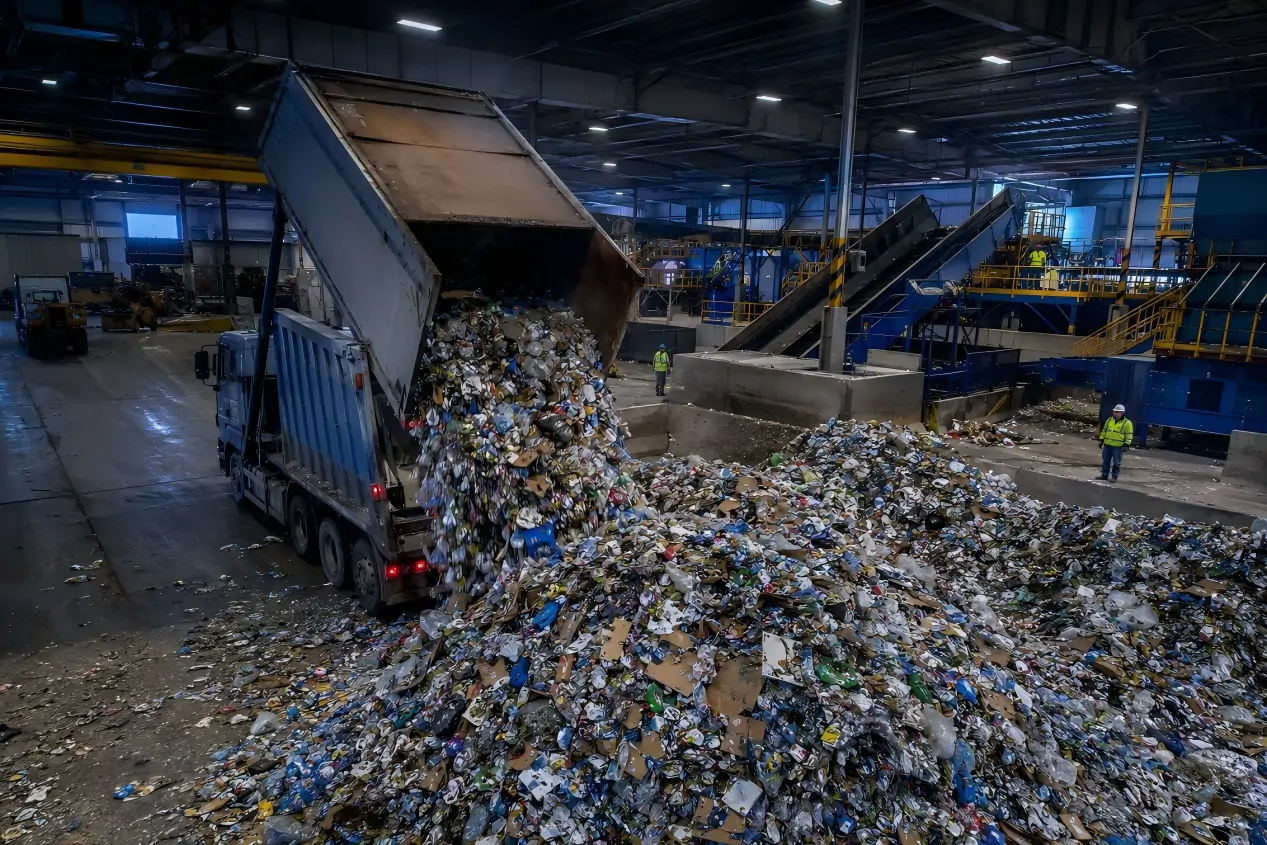
Round Flip-Flop Screen for Waste Management Processing Line
Our Cases
Custom Solutions
The Circular Motion Flip Flow Screen offers customized designs tailored to different material characteristics and on-site process conditions, including screen surface dimensions, number of layers, mesh specifications, vibration parameters, and overall structural optimization. For applications involving highly moist, sticky materials, high clay content, or complex particle size distributions, the anti-clogging structure and processing capacity can be further optimized to meet actual production requirements.
Based on specific process requirements, we provide screening and classification solutions ranging from single-unit configurations to complete systems. These solutions can be integrated with various environmental treatment production lines, such as construction waste recycling production lines, municipal solid waste sorting and treatment production lines, industrial solid waste comprehensive utilization production lines, and tailings and sludge treatment production lines. This integration ensures efficient coordination between the screening stage and the overall process, thereby improving resource recovery rates and system operational stability.
If you require a customized solution design or technical advice, please feel free to contact us. We will provide you with detailed technical support and equipment selection services.
Information required for customization:
- Material type and composition
- Processing capacity (t/h or m³/h)
- Moisture content and waste characteristics
- Required separation size range
- Site layout and installation space
- Level of automation required
- Integration with existing equipment (if any)
Why Choose us?
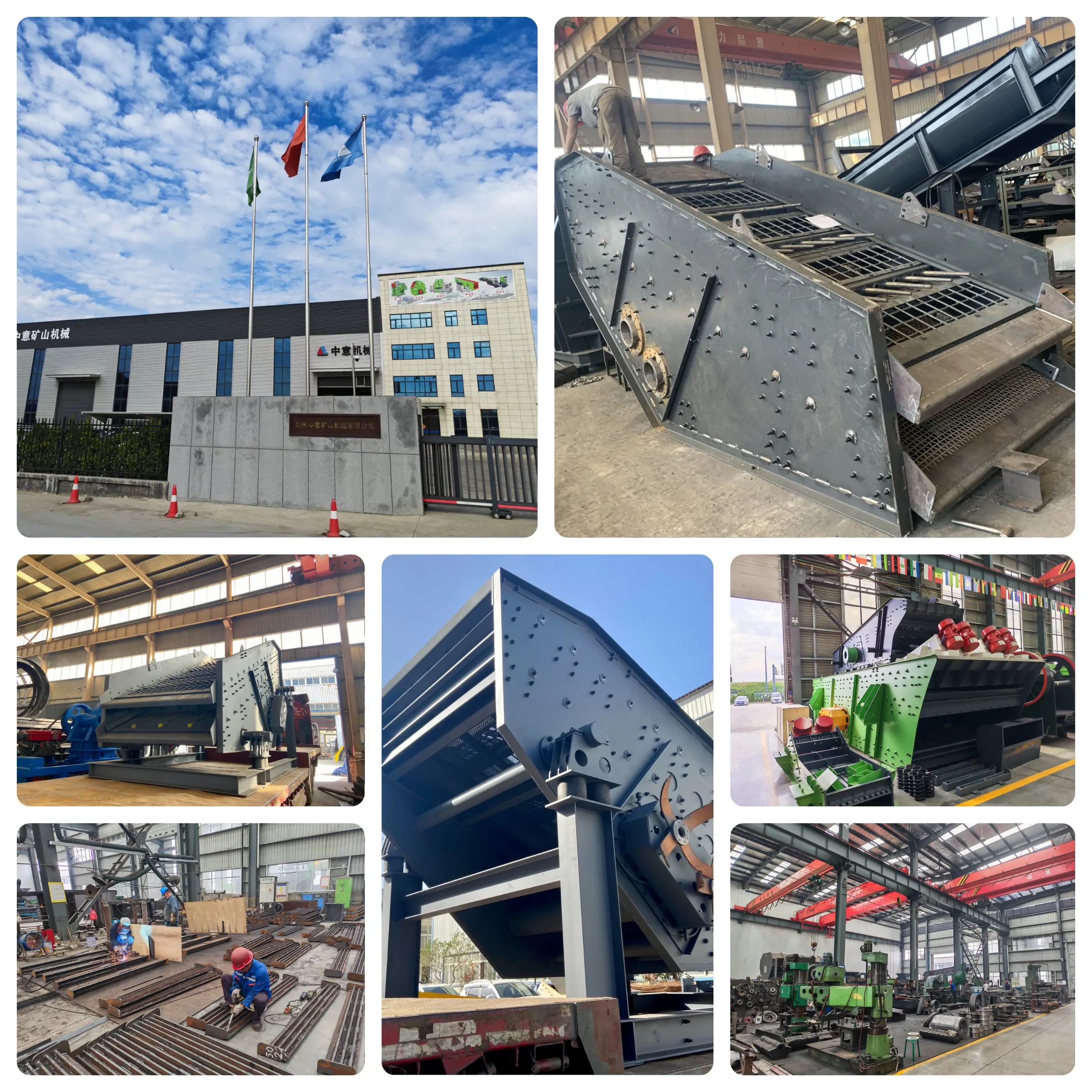
Xinzhongyi ECO focuses on in-house engineering design and equipment manufacturing for waste recycling systems. Our company supports complete project delivery from process design to equipment fabrication and system integration.
Our manufacturing and engineering capability includes:
- 16+ years experience in waste recycling equipment design and engineering
- In-house production lines for CNC machining, welding, and assembly
- Standardized manufacturing system with ISO and CE certification
- Design customization based on real waste composition and project conditions
- Full plant integration covering sorting, shredding, and screening systems
Circular Motion Flip Flow Screen Manufacturer & Supplier
Xinzhongyi ECO has over 16 years of experience in waste recycling equipment manufacturing and system engineering. We are both a manufacturer and supplier, providing complete production line solutions including design, equipment production, and system integration. Our focus is on delivering stable and practical solutions for municipal and industrial waste treatment projects.
We support customers with full project execution from single equipment supply to complete recycling plants. Each solution is designed based on real material conditions and project requirements. Our service covers equipment customization, production, installation support, and after-sales service, ensuring reliable long-term operation for different waste processing applications.
FAQ
It is mainly used for MSW, RDF, sludge, compost, biomass, and mixed construction waste with high moisture and sticky content.
The elastic screen mats keep stretching and relaxing during operation, which prevents material sticking and screen blockage.
Capacity depends on model selection, usually from 20 m³/h up to 500 m³/h in industrial waste treatment lines.
No. The self-cleaning motion of the elastic screen reduces manual cleaning during operation.
Flip Flow Screen has higher anti-clogging performance and better efficiency for wet waste, while trommel screens are more suitable for dry or pre-processed materials.
Yes. It is commonly used with shredders, bag openers, wind sifters, and sorting systems in complete MSW treatment lines.
Material type, moisture content, required capacity, particle size distribution, and plant layout are the main selection factors.